Type decisions can alter the tone of type.
Type has a visual element - it is a mixture of visual and verbal communication.
Meta-communication is a type of system that surrounds another system.
Type can affect the way/speed/rhythm that we read text.
A font could look perfectly sleek on screen, but bulky in print.
Letters come from roman inscription.
Type Classification
Humanist
Old Style
Transitional
Modern
Slab Serif
Sans Serif
The age of print began around 1450s
Gutenbergs printing press is invented, so can mass produce books. For the first time, knowledge is widely available.
Gutenberg Gothic Script was based on medievel handwriting and used in the printing press but soon fell out of favour.
Humanist typefaces were introduced, and were more legible.
To spot a humanist type, you can notice that the bar on the lowercase 'e' is inclined slightly.
Jenson - early humanist font
Designers wanted to keep human aspects to it
Geofroy Tory believed that proportions of the alphabet should reflect ideal human form.
Old Style are refined versions of humanist fonts.
Examples: Garamond, Perpetua, Palatino.
They have connotations with class, sophistication and italian renaissance.
Transitional
Contrast between thick and thin strokes
Created along quasi-scientific lines.
Baskerville was accused of 'blinding the country' with narrow strokes.
In 1790s modern typefaces were developed.
Attributed to Firmin Didot
Modern Traits
Small aperture
High contrast
Narrow hairlines
Seen in fashion all the time - seen as glamour, elegant
Slab/Egyptian
Egyptian reference is to exoticism and oriental
Designed for industrialisation, mass production, to be plastered on billboards to shout at you
Modern Sans Serif
Supposed to be international, design typeface for all, not historic, neutral.
Cooper Black - 1921 - Easyjet, The Beach Boys, Dad's Army, Vote for Pedro
Helvetica - 1957 notable as most modern/recognised font
90s onwards - designers keep inventing new fonts instead of using existing ones
The Crystal Goblet by Beatrice Warde
Context of Practice
Danielle Harrison
OUGD401 - Harvard Referencing
We have to write a 3000 word essay, with a choice of five essay titles, which are the following:
1. Focussing on specific examples, describe the way that modernist art and design was a response to the forces of modernity.
2. Choosing a particular period from 1800 to present, in what way has art and design responded to the changing social and cultural forces of that period.
3. Could it be argued that fine art ought to be assigned more 'value' than more popular forms of visual communication?
4.
5.
I think I am going to focus on the first question, which is about modernism. I have decided to look into this question further because the lecture we had on it was my favourite one so far, and I really like the simplicity and practicality which comes with the modernist characteristics.
We need an introduction and a conclusion; it has to be written in 3rd person; there has to be appropriate references to at least four academic sources and a bibliography of at least 10 sources using the harvard referencing system.
We have to find five books in relation to the question we are going to choose, and show how we would harvard reference them, as this is what we will be doing in the essay.
Klanten, R., Hellige, H. (2011) The Modernist, Berlin, Die Gestalten Verlag, 741.605.
Kennedy, A., (2006) Bauhaus, London, Flame Tree Publishing, 709.43.
Barnard, M., (2005) Graphic Design as Communication, London and New York, Routledge, 741.601.
Harris, J., Wood, P., Frascina, F., Harrison, C., (1993) Modernism in Dispute: Art Since the Forties, London, Yale University Press, 709.06.
Harrison, C., (1997) Modernism, London, Tate Publishing, 709.06.
1. Focussing on specific examples, describe the way that modernist art and design was a response to the forces of modernity.
2. Choosing a particular period from 1800 to present, in what way has art and design responded to the changing social and cultural forces of that period.
3. Could it be argued that fine art ought to be assigned more 'value' than more popular forms of visual communication?
4.
5.
I think I am going to focus on the first question, which is about modernism. I have decided to look into this question further because the lecture we had on it was my favourite one so far, and I really like the simplicity and practicality which comes with the modernist characteristics.
We need an introduction and a conclusion; it has to be written in 3rd person; there has to be appropriate references to at least four academic sources and a bibliography of at least 10 sources using the harvard referencing system.
We have to find five books in relation to the question we are going to choose, and show how we would harvard reference them, as this is what we will be doing in the essay.
Klanten, R., Hellige, H. (2011) The Modernist, Berlin, Die Gestalten Verlag, 741.605.
Kennedy, A., (2006) Bauhaus, London, Flame Tree Publishing, 709.43.
Barnard, M., (2005) Graphic Design as Communication, London and New York, Routledge, 741.601.
Harris, J., Wood, P., Frascina, F., Harrison, C., (1993) Modernism in Dispute: Art Since the Forties, London, Yale University Press, 709.06.
Harrison, C., (1997) Modernism, London, Tate Publishing, 709.06.
Lecture Notes - Graffiti and Street Art
History
Drawings and paintings on cave wall from Paleolithic period.
Scratched with animal bones and natural pigments.
Ancient Roman Graffiti from Pompeii.
Can have a political message.
Engraving of Killroy/Chad during WWII was popular around the country with a message 'wot no...' sugar, flour etc. It became a national joke, was humorous where it is placed.
Paris May '68
Civil unrest inspiring cultural and creative material
'We Are The Power'
1970s New York
Evolves around the Hip Hop culture
Announcing a presence and saying we will not be ignored
Making the language of streets visible
Spray can graffiti
Hip Hop graffiti was political, had a message to say
Whereas disco culture at the same time was superficial
John Naar, Photographer, 1973
'Becoming a Graffiti Photographer'
'were a cry for change from the ghetto to clean up the filthy streets'
Jean-Michel Basquiet (1960-88)
New-expressionism - Graffiti in paintings
Samo/Same-oh - pseudonym of same old shit
Became popular throughout Manhattan
Death of samo documented on streets 1979
Warhol and Basquiet collaborated
General Electric with Waiter, 1984
One of Americas largest corporations
Basquiet died of a herion overdose 18 months after Warhol
Keith Haring, Radiant Baby
In 1981 he sketched his first chalk drawing on black paper, metal, and other materials.
He did a lot of subway art. Sexuality was a recurring theme in his work, being a gay artist himself.
'PopShop' was his shop selling t shirts, toys, posters etc, and was closed in 2005.
He was criticised for being too commercial, but he wanted it to be affordable, everyday work rather than expensive gallery pieces.
John Feckner, Broken Promises, 1980
Jenny Holzer, Times Square Show, 1980
Her work mimics overload of usual information on street, and uses LCD screen rather than stencil like Feckner.
Video Game Culture
Comment on lack of technology available in Eastern Block.
Feeliz 1984 - on Berlin Wall.
Tats Cru, 1997, for Coca Cola
Bomb The World (PS2) 2004, a game where you can spray paint towns
Invader
French Artist, born 1969
First mosaic in mid 1990s Paris
Tiles are pixel like
They are permanent as weatherproof, and difficult to remove
Conceptual element: points on a map from a space invader
'Attack on Montpellier'
Almost a form of real game play, as he sets you on a mission to look for all his artworks
Re-emergence of street art now
Sherpherd Fairey, 2008, Obama campaign
Banksy, Kate Moss, in style of Warhol
Parisian photographer JR, Favela Morro Da Provienda - Rio 2008
Blu (Italy) and Os Gemeos (Brazil) Lisbon 2010. Created an enlarged man drinking from the World, wearing a crown with lots of oil companies. It was a social comment
Blu is known for his animated graffiti
Corsa Ad 2011
123 Klan
Founded as a graffiti crew in 1989 by Scien and Klor, turned their hands to illustration while maintaining graffiti style.
Paul Curtis (Moose)
Reverse Graffiti
Uses stencils to water blast of dirt to make image
Free Art Friday
Create free art, place it somewhere public, and attach a tag to it saying 'take me home and enjoy'
Some make game out of it and leave clues on Twitter
Sam 3 (Spain) Murcia 2010
Only uses black paint
Graffiti is a way of escaping gender. Doesn't matter if you are male of female.
Diva is a female artist
Miss Van, Fafi and Swoon paint women to feminise the streets
Ganz Nicholas, Graffiti Woman
Drawings and paintings on cave wall from Paleolithic period.
Scratched with animal bones and natural pigments.
Ancient Roman Graffiti from Pompeii.
Can have a political message.
Engraving of Killroy/Chad during WWII was popular around the country with a message 'wot no...' sugar, flour etc. It became a national joke, was humorous where it is placed.
Paris May '68
Civil unrest inspiring cultural and creative material
'We Are The Power'
1970s New York
Evolves around the Hip Hop culture
Announcing a presence and saying we will not be ignored
Making the language of streets visible
Spray can graffiti
Hip Hop graffiti was political, had a message to say
Whereas disco culture at the same time was superficial
John Naar, Photographer, 1973
'Becoming a Graffiti Photographer'
'were a cry for change from the ghetto to clean up the filthy streets'
Jean-Michel Basquiet (1960-88)
New-expressionism - Graffiti in paintings
Samo/Same-oh - pseudonym of same old shit
Became popular throughout Manhattan
Death of samo documented on streets 1979
Warhol and Basquiet collaborated
General Electric with Waiter, 1984
One of Americas largest corporations
Basquiet died of a herion overdose 18 months after Warhol
Keith Haring, Radiant Baby
In 1981 he sketched his first chalk drawing on black paper, metal, and other materials.
He did a lot of subway art. Sexuality was a recurring theme in his work, being a gay artist himself.
'PopShop' was his shop selling t shirts, toys, posters etc, and was closed in 2005.
He was criticised for being too commercial, but he wanted it to be affordable, everyday work rather than expensive gallery pieces.
John Feckner, Broken Promises, 1980
Jenny Holzer, Times Square Show, 1980
Her work mimics overload of usual information on street, and uses LCD screen rather than stencil like Feckner.
Video Game Culture
Comment on lack of technology available in Eastern Block.
Feeliz 1984 - on Berlin Wall.
Tats Cru, 1997, for Coca Cola
Bomb The World (PS2) 2004, a game where you can spray paint towns
Invader
French Artist, born 1969
First mosaic in mid 1990s Paris
Tiles are pixel like
They are permanent as weatherproof, and difficult to remove
Conceptual element: points on a map from a space invader
'Attack on Montpellier'
Almost a form of real game play, as he sets you on a mission to look for all his artworks
Re-emergence of street art now
Sherpherd Fairey, 2008, Obama campaign
Banksy, Kate Moss, in style of Warhol
Parisian photographer JR, Favela Morro Da Provienda - Rio 2008
Blu (Italy) and Os Gemeos (Brazil) Lisbon 2010. Created an enlarged man drinking from the World, wearing a crown with lots of oil companies. It was a social comment
Blu is known for his animated graffiti
Corsa Ad 2011
123 Klan
Founded as a graffiti crew in 1989 by Scien and Klor, turned their hands to illustration while maintaining graffiti style.
Paul Curtis (Moose)
Reverse Graffiti
Uses stencils to water blast of dirt to make image
Free Art Friday
Create free art, place it somewhere public, and attach a tag to it saying 'take me home and enjoy'
Some make game out of it and leave clues on Twitter
Sam 3 (Spain) Murcia 2010
Only uses black paint
Graffiti is a way of escaping gender. Doesn't matter if you are male of female.
Diva is a female artist
Miss Van, Fafi and Swoon paint women to feminise the streets
Ganz Nicholas, Graffiti Woman
OUGD403 - Message and Delivery: Research Pt3
For the Message and Delivery: Distribution part of the brief, we have to create a mail shot using the same message that we came up with for the three posters. I have two ideas that I want to explore further which are raising awareness for inequality in the workplace, and raising awareness for a women's charity.
To complete the brief I have started to compile some further research together to help me with my message.
'Gender Inequality still an issue in the workplace'
‘There’s no question that the gender pay gap is alive and well, particularly in the top ASX companies,’ Federal Sex Discrimination Commissioner Elizabeth Broderick told ABC News Online. Only 13 of the 500 largest companies in the world have female CEOs.'
'Pay inequality is most blatant in the finance and insurance industry, according to research by the EOWWA (Equal Opportunity for Women in the Workplace Agency) revealing that women in the industry are paid 40 per cent less than men. Only 17 per cent of Certified Financial Planners (CFPs) in Australia are female.'
As it says 'pay inequality is most blatant in the finance and insurance industry' these could be one of of companies I send a mail shot to, as then the women in the company can question the company, and the company can be made aware of the discrimination.
Because the research is by the Equal Opportunity for Women in the Workplace Agency I decided to research them further, and I found another article on 'Women falling from executive ranks'. I found some statements from it which could be helpful for my brief:
'The number of companies with no women executive managers has risen sharply to 45.5 percent, up from 39.5 percent in 2006'
'While 54.5 percent of Australian ASX 200 companies have at least one woman in an executive position, this compares poorly to the US where 85.2 percent of companies do. In Canada the figure is 65.6 percent, Britain 60 percent and South Africa 59.3 percent.'
'while more women than ever were participating in the workforce, they were overwhelmingly represented in the low-paid, low status roles.'
I think these statistics and statements are really useful to me because they highlight the fact there are definite inequalities, however, the EOWWA are an Australian government agency, so I highlighted the part where it says 'Britain 60 percent' because that is relevant to this country. Now I am going to research the same subject but look for examples in the UK.
I found an essay on 'Women and Gender Equity in Employment', which talks about the subject in depth in the UK, so relates to my message and recipients a lot more. Here is another study on the same topic.
I found a very recent set of statistics stating the exact amount women are paid less than men from the BBC website.

'The latest numbers from the Professional Boards Forum show that 17.3% of FTSE 100 directors are women, a rise from 12.5% when Lord Davies published his 2011 report setting a voluntary target of 25% of board seats being filled by female directors by 2015.'
I found some more statistics on the Guardian


I then started to look into my second idea of raising awareness for a women's charity, and went onto the Women's Aid website and looked at a campaign called EQUALS.

To complete the brief I have started to compile some further research together to help me with my message.
'Gender Inequality still an issue in the workplace'
‘There’s no question that the gender pay gap is alive and well, particularly in the top ASX companies,’ Federal Sex Discrimination Commissioner Elizabeth Broderick told ABC News Online. Only 13 of the 500 largest companies in the world have female CEOs.'
I picked out this key point because the statistic 'Only 13 of the 500 largest companies in the world have female CEOs' highlights the big gender gap is on a worldwide scale, and some of the companies could be one of the recipients of the mail shot to make them aware of the gender inequality in their workplace.
'Pay inequality is most blatant in the finance and insurance industry, according to research by the EOWWA (Equal Opportunity for Women in the Workplace Agency) revealing that women in the industry are paid 40 per cent less than men. Only 17 per cent of Certified Financial Planners (CFPs) in Australia are female.'
As it says 'pay inequality is most blatant in the finance and insurance industry' these could be one of of companies I send a mail shot to, as then the women in the company can question the company, and the company can be made aware of the discrimination.
Because the research is by the Equal Opportunity for Women in the Workplace Agency I decided to research them further, and I found another article on 'Women falling from executive ranks'. I found some statements from it which could be helpful for my brief:
'The number of companies with no women executive managers has risen sharply to 45.5 percent, up from 39.5 percent in 2006'
'While 54.5 percent of Australian ASX 200 companies have at least one woman in an executive position, this compares poorly to the US where 85.2 percent of companies do. In Canada the figure is 65.6 percent, Britain 60 percent and South Africa 59.3 percent.'
'while more women than ever were participating in the workforce, they were overwhelmingly represented in the low-paid, low status roles.'
I think these statistics and statements are really useful to me because they highlight the fact there are definite inequalities, however, the EOWWA are an Australian government agency, so I highlighted the part where it says 'Britain 60 percent' because that is relevant to this country. Now I am going to research the same subject but look for examples in the UK.
I found an essay on 'Women and Gender Equity in Employment', which talks about the subject in depth in the UK, so relates to my message and recipients a lot more. Here is another study on the same topic.
I found a very recent set of statistics stating the exact amount women are paid less than men from the BBC website.

I then found a another article stating exactly how many women are FTSE 100 directors.
'The latest numbers from the Professional Boards Forum show that 17.3% of FTSE 100 directors are women, a rise from 12.5% when Lord Davies published his 2011 report setting a voluntary target of 25% of board seats being filled by female directors by 2015.'
I found some more statistics on the Guardian


I then started to look into my second idea of raising awareness for a women's charity, and went onto the Women's Aid website and looked at a campaign called EQUALS.

When I started reading it, it was about the belief that men and women should be equal, which fits into the previous research I was doing about gender inequality in the workplace. So I've decided to go with my first idea as the message still supports women and equality, like this charity does.
OUGD401 - Creative Advertising Lecture Notes
History of Creative Advertising
Large scale colour printing technology developed 19c.
Advertising, The most fun you can have with your clothes on! (R4, 2009)
Robin Wight (WCRS) - 118 118 and The Futures Bright, The Futures Orange
Bill Berndach - first to combine copywright and art direction
Lever Brothers founders James Darcy and William Hesketh Lever (1885)
Ubiquitious brand
George Cruikshank (etching) All of the world going to see the exhibiton of 1851
About the big exhibition in London
Colour printing was practised until well into the 19th century, with publications generated by the Great Exhibition of 1851.
An essential componant of any competitive market economy
1860s cereal company Kelloggs figured out how to print, fold and fill cardboard boxes mechanically
Lever was first one to pre package a tablet of soap - same sized bar each time, as beforehand it was sold in a grocers in a long bar which was cut up
It added brand value through packaging
Technological progress reproduction and colour printing, pictorial ads in magazines in 1860s.
1890s technology enabled contemporary paintings to be reproduced
Ad transformed company from a local soap manufactor in 1885, Unilever, is now one of the biggest companies
The New Frock, 1889, William Powell, soap ad
Children were popular subjects in 1850s as they signifed joy, purity and innocence
A Dress Rehearsal, 1888, Leverhulme used it for 1889 advertisement As Good As You
He would pick paintings to be in his advertisements
Emotional stratedy enhanced by naturalism of Newlyn school
Implies dress worn by brides mother passing down beauty secrets
First creative advertising
Selecting + presenting contemporary art work from Royal Academy communicated more powerfully the desired message.
A list of ads were text based only on shop fronts (1960s)
Hegarty 2011 - Advertising from the moment it was born, was trying to entertain us.
Beginning of 20th century, creative advertising agencies began offering a creative service.
Medicine, soap and chocolate are among foremost to be advertised globally
The Wedding Morning, (1892)
Royal endorsement from 1892, soap makers to Queen Vic
Democratisation
'Queens will only have the best... Sunlight soap is so cheap everyone can afford to use it'
One method of advertising was to capture children - in packs of soap you could collect free dolls with interchangeable clothes and collect coupons for encyclopedias
Lever thought train doors would be good to advertise on as they are always left open at station
He avoided advertising in left wing newspapers. He was among the innovators of advertising experise.
Many of his ads emphasised Sunlight would save women from drudgery as soap would make washing quicker
Advertisers made it their busines to persuade customers of their hygiene. If one wished to gain a job, self-esteem and partner they would have to smell good.
Large scale colour printing technology developed 19c.
Advertising, The most fun you can have with your clothes on! (R4, 2009)
Robin Wight (WCRS) - 118 118 and The Futures Bright, The Futures Orange
Bill Berndach - first to combine copywright and art direction
Lever Brothers founders James Darcy and William Hesketh Lever (1885)
Ubiquitious brand
George Cruikshank (etching) All of the world going to see the exhibiton of 1851
About the big exhibition in London
Colour printing was practised until well into the 19th century, with publications generated by the Great Exhibition of 1851.
An essential componant of any competitive market economy
1860s cereal company Kelloggs figured out how to print, fold and fill cardboard boxes mechanically
Lever was first one to pre package a tablet of soap - same sized bar each time, as beforehand it was sold in a grocers in a long bar which was cut up
It added brand value through packaging
Technological progress reproduction and colour printing, pictorial ads in magazines in 1860s.
1890s technology enabled contemporary paintings to be reproduced
Ad transformed company from a local soap manufactor in 1885, Unilever, is now one of the biggest companies
The New Frock, 1889, William Powell, soap ad
Children were popular subjects in 1850s as they signifed joy, purity and innocence
A Dress Rehearsal, 1888, Leverhulme used it for 1889 advertisement As Good As You
He would pick paintings to be in his advertisements
Emotional stratedy enhanced by naturalism of Newlyn school
Implies dress worn by brides mother passing down beauty secrets
First creative advertising
Selecting + presenting contemporary art work from Royal Academy communicated more powerfully the desired message.
A list of ads were text based only on shop fronts (1960s)
Hegarty 2011 - Advertising from the moment it was born, was trying to entertain us.
Beginning of 20th century, creative advertising agencies began offering a creative service.
Medicine, soap and chocolate are among foremost to be advertised globally
The Wedding Morning, (1892)
Royal endorsement from 1892, soap makers to Queen Vic
Democratisation
'Queens will only have the best... Sunlight soap is so cheap everyone can afford to use it'
One method of advertising was to capture children - in packs of soap you could collect free dolls with interchangeable clothes and collect coupons for encyclopedias
Lever thought train doors would be good to advertise on as they are always left open at station
He avoided advertising in left wing newspapers. He was among the innovators of advertising experise.
Many of his ads emphasised Sunlight would save women from drudgery as soap would make washing quicker
Advertisers made it their busines to persuade customers of their hygiene. If one wished to gain a job, self-esteem and partner they would have to smell good.
OUGD403 - Message and Delivery Pt2

What I find interesting is how women's roles in society are percieved, and how this story can be seen as a celebratory thing that women now have a bigger role in the army, but it can also be seen as something which is still an incredibly inequal job as only 9.1% of the British Army are in fact women, and they cannot do every job available.

To be in the army is a brave thing to do because of the high risks involved. The fact that women want to be involved with the army still even though they are not allowed to do all of the jobs shows how much they want to be involved. I want to research further into how talented and brave women are, but how we are still treated unfairly when it comes to equality between men and women.
This is a video showing the exhibition in which Baskerville's photographs were shown. Baskerville says that the project documents the 'daily life' of women and 'looking at their lifes behind what everyone percieves as normal'. I want to explore further what people do percieve as normal, and not just women in the army, but the roles which society think women should do.

This phenomonal infographic indicates the amount of work that women in third world countries have to do, just to provide for their families. Even though it depicts women being maternal, which is what they are all seen to be in our society and media, it also shows them being incredibly hard grafters which is supposed to be the 'man's job'.
On the same website it says 'Surveys from 45 developing countries show that women and children bear the primary responsibility for water collection in the majority of households. This is time not spent working at an income-generating job, caring for family members, or attending school.'
Because women and children have this massive responsibility to their family, they are restricted from having careers and getting an education, which is appalling considering we are now in the 21st century, and women are still denied these privileges.
It says the amount of work that women do in one day, 28 empire state buildings could be made in one day due to the amount of hours that go into both. This is an astonishing fact, and it is not recognised in the media the amount of work that women do.
A prime example of how women are subjected to the media is the Moors Murders. Myra Hindley and Ian Brady were part of a high profile murder case were together they murdered and sexually assaulted five children. Even though it happened between 1963-65 it is still widely well known, and the public's hatred for Myra Hindley is still as strong today as it ever was. Although they both committed the crimes, it is Hindley who is most remembered and talked about:
'it was Hindley's gender that made her so vilified. Brady, who says that he does not want to be released, was rarely mentioned in the news, but Hindley's repeated insistence on her innocence, followed by her attempts to secure her release after confessing her guilt, resulted in her becoming a figure of hate in the national media. Her oft-reprinted photograph, taken shortly after she was arrested, is described by some commentators as similar to the mythical Medusa and, according to author Helen Birch, has become "synonymous with the idea of feminine evil".'
This section from Wikipedia describes how it is her gender which makes her more talked about than her partner Brady. Because every woman is thought to have a maternal instinct, the public found it impossible how a female can commit these crimes to children, which is what makes it so shocking. She committed an unforgiveable crime, but so did Brady, so surely he should have recieved the same abuse that she did?
 Artist Marcus Harvey created a portrait of Myra Hindley for the Sensation exhibition at the Royal Academy of Art in 1995. It is made out of childrens handprints, and was an incredibly controversial exhibition piece, which recieved outrage from the public. Harvey has said: "The whole point of the painting is the photograph. That photograph.
The iconic power that has come to it as a result of years of obsessive
media reproduction."
Artist Marcus Harvey created a portrait of Myra Hindley for the Sensation exhibition at the Royal Academy of Art in 1995. It is made out of childrens handprints, and was an incredibly controversial exhibition piece, which recieved outrage from the public. Harvey has said: "The whole point of the painting is the photograph. That photograph.
The iconic power that has come to it as a result of years of obsessive
media reproduction."The same year that Hindley and Brady started committing the murders together, Betty Friedan published a book in America, The Feminine Mystique. Friedan wrote about women's lives at that time in America, and 'defined 'the problem that has no name.'' It is an incredibly influential book, and sparked the second wave of feminism. Here are a couple of quotes from the book:
“Each suburban wife struggles with it alone. As she made the beds, shopped for groceries, matched slipcover material, ate peanut butter sandwiches with her children, chauffeured Cub Scouts and Brownies, lay beside her husband at night- she was afraid to ask even of herself the silent question-- 'Is this all?”
― Betty Friedan, The Feminine Mystique
"Here are the complete editorial contents of a typical issue of McCall's (July, 1960):
1. A lead article on "increasing baldness in women," caused by too much brushing and dyeing.
2. A long poem in primer-size type about a child, called 'A Boy Is A Boy'
3. A short story about how a teenager who doesn't go to college gets a man away from a bright college girl.
4. A short story about the minute sensations of a baby throwing his bottle out of the crib.
5. The first of a two-part intimate 'up-to-date' account by the Duke of Windsor on 'How the Duchess and I now live and spend our time. The influence of clothes on me and vice versa.'
6. A short story about a nineteen-year-old girl sent to a charm school to learn how to bat her eyelashes and lose at tennis. ('You're nineteen, and by normal American standards, I now am entitled to have you taken off my hands, legally and financially, by some beardless youth who will spirit you away while he learns the chicanery of selling bonds. And no beardless youth is going to do that as long as you volley to his backhand.')
7. The story of a honeymoon couple commuting between separate bedrooms after an argument over gambling at Las Vegas.
8. An article on 'how to overcome an inferiority complex'.
9. A story called 'Wedding Day'.
10. The story of a teenager's mother who learns how to dance rock-n-roll.
11. Six pags of glamorous pictures of models in maternity clothes.
12. Four glamorous pages on 'reduce the way models do'.
13. An article on airline delays.
14. Patterns for home sewing.
15. Patterns with which to make 'Folding Screens - Bewitching Magic.'
16. An article called 'An Encyclpedic Approach to Finding a Second Husband.'
17. A 'barbecue bonanza', dedicated 'to the Great American Mister who stands, chef's cap on head, fork in hand, on terrace or back porch, in patio or backyard anywhere in the land, watching his roast turning on the spit. And to his wife, without whom (sometimes) the barbecue could never be the smashing summer success it undoubtedly is...''
― Betty Friedan, The Feminine Mystique


The fact that the whole contents on that particular McCall's magazine was entirely focused on home-keeping, marriage and children suggests that that is all women were allowed to be interested in, and nobody thought to create a magazine which allowed women to have any hobbies other than sewing, any goal other than getting a husband, or any other reading material about women living the life that should be aspiring to.
The first image from McCall's magazine shows women looking glamorous in aprons, supporting the idea that women should be in the kitchen, and enforcing the stereotype of women rather than fighting it.
The second image shows a mother with her two children, showing the ideal american family. Having this image gives out the message to women that if you have this, you will be happy, and that is all you need. However, that is what Friedan's book is about - women who have a family and husband, but still aren't satisfied. Because even though they are told this is all they can achieve, they started to realise that wasn't just what life is about.
That was fifty years ago, and inequality between men and women still exists today. I found a tumblr called http://whoneedsfeminism.tumblr.com and it shows women's reasons why they need feminism and equality. Here is the aim of the tumblr site:
About

Identify yourself as a feminist today and many people will immediately assume you are man-hating, bra-burning, whiny liberal. Perhaps a certain charming radio talk show host will label you as a “Feminazi” or “slut.” Even among more moderate crowds, feminism is still seen as too radical, too uncomfortable, or simply unnecessary. Feminism is both misunderstood and denigrated regularly right here on Duke’s campus. We, the 16 women of Professor Rachel Seidman’s course on Women in the Public Sphere, have decided to fight back against these popular misconceptions surrounding the feminist movement. Our class was disturbed by what we perceive to be an overwhelmingly widespread belief among students that today’s society no longer needs feminism. In order to change this perception on campus, we have launched a PR campaign for feminism. We aim to challenge existing stereotypes surrounding feminists and assert the importance of feminism today.
I've highlighted certain parts in bold which I feel are the most important to me, and I decided to look at some of the posts people contributed to the site.

The fact this woman felt that she had to remove her post shows that men making objectifying comments is actually intereferring with women's lives.

I have experienced so many times when males have said to me, my friends and work colleagues that we must be on our period because we are stressed.

This problem still exists fifty years after Friedan published The Feminine Mystique.


I wanted to look at some more advertisements where women are stereotypically subjected, and I wanted to look at how adverts have changed from then and now.
This is a genuine tv advert from the 1960s, and it shows a woman, very happy, cleaning her kitchen with a flash product. There is no man helping her, and her kitchen is spotless - suggesting that it is a womans job, and that they enjoy doing it.
This advert from the 1950s is selling a skin product, and they are doing that by saying if you use it, men will be attracted to you. This is objectifying women, and the voiceover uses words such as 'young, fresh, flawless' and 'this is the look he will notice', persuading women to buy this product.
This advert is called 'best beer ad ever'. It is a more recent one, and, like most beer adverts, uses women to advertise the beer which are targeted at men. At the end of the advert she actually rubs her breasts into his face, all the while seductive music is playing. So although it is a lot different from the previous advert, they still use lust and objectify women to sell their products.
I have made a lot of opinons on why I think all of these examples are a reason why we need feminism, but now I want to look at some proper facts and figures to show that the problem does exist. I found a really good PDF on some facts about women, and if you click here you can see them all.

The statistic that only 19.1% of women have a seat in parliament shows just how much men and women are still not equal, as it isn't doesn't match a fifth of men in the room. This means women's opinions aren't heard as much because there aren't as many.

Only 16% of stories in the news and media are entirely focused on women, meaning all the problems that women face are certainly not documented as much as they should be, which could possibly suggest why feminism isn't taken seriously.
 This section on violence against women is crucial because it says that 71% of women have been physically or sexually assaulted by their husband and partner, which just shows mens attitudes to women, and how they think it is acceptable to treat them this way.


This shows how gender inequality is significant in the business sector globally, and is a document by Oxfam which you can find if you click here.
Now I have done this research, I am moving on to my next task which involves creating three posters which can be found here on my design practise blog.
OUGD401 - Postmodernist/Modernist Critical Analysis
Find
5 images of Modernist graphic design and 5 images of postmodernist
graphic design. Write a short critical analysis of each image
Postmodernism
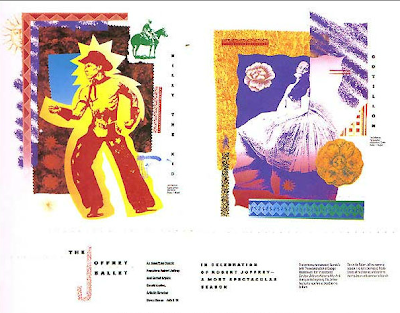
Michael Cronan
One of the fundamentals of modernism was that there should be no decoration or ornamentation as it will only become dated - this is why I think this magazine spread is a prime example of postmodernism because Cronan has used a multitude of colours, patterns and techniques which make it look extremely cluttered. It was published in 1990, which was when Photoshop 1.0 was created and I think the patterns used definitely reflect that as the textures, gradients and strokes used look computerised. I personally don't like the image because I think a lot of the textures are pointless, and I think the effects used on the photographs are tacky. Massimo Vignelli said that 'Modernism was a commitment against greed, commercialization, exploitation, vulgarisation, cheapness.' As postmodernism was a rebellion against all the principles of modernism, this quote supports the fact this magazine spread is a postmodernist piece of graphic design, because it is incredibly vulgar and its style is very cheap looking as it is so easy to achieve, and there seems to be no thought gone into the layout and colour.

Raygun Magazine
David Carson was the art director for magazine Raygun, which was very controversial for the way he didn't follow the organised rules of modernism in terms of layout and editorial design. In an interview for the film Helvetica, he spoke about this particular article which was about the musician Bryan Ferry. He thought that the article was incredibly boring and not worth reading, so he published the whole article in Dingbat - a font made entirely of images, therefore illegible. I admire how he wasn't afraid to publish his own opinions, but the article was actually printed in a readable font at the end of the magazine, so what was the point of doing this in the first place? The purpose of the article is to be read, and as it cannot be read it has no purpose, which I think makes it postmodernist because one of the key charateristics of the movement is that it doesn't have to make sense, and the designer or artist can create anything they want without it having to mean anything to anyone else. This is why I dont like postmodernism, because to me the idea of graphic design is to communicate to a wide range of people, which this can't.

April Greiman
Greiman is noted as one of the first designers to produce design solely on computers, and create digital art. Here is an example of one of her magazine covers for WET, which I think is postmodernist because it is a collage, a common medium for postmodernists to design in, and the images used are very random. It is also very typical of Greiman as there is a lot of computerised methods used, such as different gradients and shapes. It is not completely functional as the image of the person in the middle has a black rectangle over his eyes, preventing the audience from recognising him. As there are a lot of different shapes which make up most of the design I don't think it is very successful as it doesn't give you much of an insight to the contents of the magazine.

Jamie Reid
This was the back of an album cover for Sex Pistols, Never Mind The Bollocks. It is from the punk era, and one of the characteristics of this was type cut up from magazines and newspapers on designs, which can be seen here. A common theme of postmodernism is chaotic bricolage, which can be seen here by how the track listing is scattered, and how the text is placed on different shaped, roughly cut out shapes. I don't like this design because it looks too unorganised, and created with no skill or precision involved.

Terry Jones
Published in 1980, i-D was a british youth culture magazine designed by Terry Jones. I think it is postmodernist because of the high contrast, bright colours used which are very tacky and kitsch. It says 'worldwide manual of style' which I think is very ironic because the cover itself is incredibly ugly. Postmodernism is known for being tacky, with designers rebelling against the rules and constraints of modernism. I guess it is successful in the fact that is eye-catching, but I just don't think it is very aesthetically pleasing.
Modernism

New Graphic Design
This is a typical example of modenrism. It is a magazine front cover, and the title is in three different languages, as modernism was an internationalist movement where its aim was for everyone to understand the design. The number '1' is enlarged, which was a typical trait of the Bauhaus which was a modernist art school. The contents is on the front page, so that it gives the audience an insight to what the magazine is about. This is very functional as before someone buys it they can see exactly whats in it. There is no illustration or photographs, as there is no need for any - the type lets the viewer know all the information they need, and modermism follows the principle that function comes before aesthetics. The fact it is in black and white could also show that it is practical and cost saving, because it is cheaper to print on black and white than it is in colour. It also uses a simple grid system so that it is very readable - much different to the magazine covers from the postmodernist movement.

 This is a music festival poster, and i think it is modernist because although there is illustration within the guitar, that shows yout the type of music which is played there, therefore communicates information. Also, parts of the guitar are used to contain the type which is needed to pass on the information to the audience. I really like this poster because of its simplicity and the composition of the illustration.

Toscatti
Toscatti is a kitchenware brand, and they have a wide range of containers, all of which are varying sizes. Anagrama created the identity for the brand, and the packaging categorises the containers in a logical way. They are colour coded into the different shapes, and the capacity of the containers are a main focus of the packaging as this is a big part of choosing what containers to buy. I think it is modernist because it is very functional - the focus of the packaging is to advertise the products function. The design is very simple, and the layout is very straightforward, making it very legible which is a charateristic of modernism. Also, the numbers are considerably larger than the text which is actually one of the formats the Bauhaus used a lot.

Postmodernism

Michael Cronan
One of the fundamentals of modernism was that there should be no decoration or ornamentation as it will only become dated - this is why I think this magazine spread is a prime example of postmodernism because Cronan has used a multitude of colours, patterns and techniques which make it look extremely cluttered. It was published in 1990, which was when Photoshop 1.0 was created and I think the patterns used definitely reflect that as the textures, gradients and strokes used look computerised. I personally don't like the image because I think a lot of the textures are pointless, and I think the effects used on the photographs are tacky. Massimo Vignelli said that 'Modernism was a commitment against greed, commercialization, exploitation, vulgarisation, cheapness.' As postmodernism was a rebellion against all the principles of modernism, this quote supports the fact this magazine spread is a postmodernist piece of graphic design, because it is incredibly vulgar and its style is very cheap looking as it is so easy to achieve, and there seems to be no thought gone into the layout and colour.

Raygun Magazine
David Carson was the art director for magazine Raygun, which was very controversial for the way he didn't follow the organised rules of modernism in terms of layout and editorial design. In an interview for the film Helvetica, he spoke about this particular article which was about the musician Bryan Ferry. He thought that the article was incredibly boring and not worth reading, so he published the whole article in Dingbat - a font made entirely of images, therefore illegible. I admire how he wasn't afraid to publish his own opinions, but the article was actually printed in a readable font at the end of the magazine, so what was the point of doing this in the first place? The purpose of the article is to be read, and as it cannot be read it has no purpose, which I think makes it postmodernist because one of the key charateristics of the movement is that it doesn't have to make sense, and the designer or artist can create anything they want without it having to mean anything to anyone else. This is why I dont like postmodernism, because to me the idea of graphic design is to communicate to a wide range of people, which this can't.

Greiman is noted as one of the first designers to produce design solely on computers, and create digital art. Here is an example of one of her magazine covers for WET, which I think is postmodernist because it is a collage, a common medium for postmodernists to design in, and the images used are very random. It is also very typical of Greiman as there is a lot of computerised methods used, such as different gradients and shapes. It is not completely functional as the image of the person in the middle has a black rectangle over his eyes, preventing the audience from recognising him. As there are a lot of different shapes which make up most of the design I don't think it is very successful as it doesn't give you much of an insight to the contents of the magazine.

Jamie Reid
This was the back of an album cover for Sex Pistols, Never Mind The Bollocks. It is from the punk era, and one of the characteristics of this was type cut up from magazines and newspapers on designs, which can be seen here. A common theme of postmodernism is chaotic bricolage, which can be seen here by how the track listing is scattered, and how the text is placed on different shaped, roughly cut out shapes. I don't like this design because it looks too unorganised, and created with no skill or precision involved.

Terry Jones
Published in 1980, i-D was a british youth culture magazine designed by Terry Jones. I think it is postmodernist because of the high contrast, bright colours used which are very tacky and kitsch. It says 'worldwide manual of style' which I think is very ironic because the cover itself is incredibly ugly. Postmodernism is known for being tacky, with designers rebelling against the rules and constraints of modernism. I guess it is successful in the fact that is eye-catching, but I just don't think it is very aesthetically pleasing.
Modernism

New Graphic Design
This is a typical example of modenrism. It is a magazine front cover, and the title is in three different languages, as modernism was an internationalist movement where its aim was for everyone to understand the design. The number '1' is enlarged, which was a typical trait of the Bauhaus which was a modernist art school. The contents is on the front page, so that it gives the audience an insight to what the magazine is about. This is very functional as before someone buys it they can see exactly whats in it. There is no illustration or photographs, as there is no need for any - the type lets the viewer know all the information they need, and modermism follows the principle that function comes before aesthetics. The fact it is in black and white could also show that it is practical and cost saving, because it is cheaper to print on black and white than it is in colour. It also uses a simple grid system so that it is very readable - much different to the magazine covers from the postmodernist movement.

Bayer was one of the teachers at Bahaus, and is known for creating many fonts. In the modernist movement, sans serifs were introduced as serifs weren't needed, and the main concept of modernism was to strip design down of ornamentation and concentrate on the most practial way of doing things. These are two fonts that he designed, and they are very simple letterforms, just serving their purpose of communication.


Toscatti
Toscatti is a kitchenware brand, and they have a wide range of containers, all of which are varying sizes. Anagrama created the identity for the brand, and the packaging categorises the containers in a logical way. They are colour coded into the different shapes, and the capacity of the containers are a main focus of the packaging as this is a big part of choosing what containers to buy. I think it is modernist because it is very functional - the focus of the packaging is to advertise the products function. The design is very simple, and the layout is very straightforward, making it very legible which is a charateristic of modernism. Also, the numbers are considerably larger than the text which is actually one of the formats the Bauhaus used a lot.

These business cards for graphic designer Laura Slater are printed on 2mm thick cairn board sand, which I think is modernist because you can still tell what material has been used, and the designer hasn't tried to hide the material it has been printed on. The design is very simple, using one colour to convey the type of design she does. Her name is also in lowercase letters, which is something some modernists liked to use because they didn't think uppercase letters were needed.
Subscribe to:
Comments (Atom)
Copyright 2010. All rights reserved.
RSS Feed. This blog is proudly powered by Blogger and uses Modern Clix, a theme by Rodrigo Galindez. Modern Clix blogger template by Introblogger.