OUGD501 - Lecture Notes: Ethics - What is Good?

We live in a fundamentally unfair, capitalist system. It is based on exploitation and inequality. And as such, how can we exist within an unfair system and say that we are good, ethical people.

First Things First
1964 manifesto by Ken Garland. Celebration of designers, and a sigh at the exploitation of creative talent in a capitalist society. Says its unethical to waste talent for pointless things for the benefit of capitalist people.

First Things First 2000
Re-released by adbusters magazine, which is an anti-capitalist magazine. They republished and revised the manifesto, and the tone changes to not just be a cry about wasting talent and doing something for a social cause, it gets more venomous and targets advertising. 

The differences are really important between the two, and in the second one:
They pick out advertising to be the worst thing
Accusing designers of being part of a system that creates meaningless products so people buy things they don't need
Says that designers are uncomfortable with this and don't want to be a part of it anymore
Saying by producing any work which is consumerist is really bad and unethical as it is ruining the world, and should be opposing capitalism
Should use visual skills to say how bad consumerism is
In the second manifesto really famous and rich designers signed it, and it's really easy to turn their nose down at people 'with no ethics' because they don't have money or buying a house to worry about, as a lot of designers don't have the luxury of choosing who they work for and need money to live in the world

Victor Papanek
A really interesting writer, who although isn't an academic write a lot of books

'Most things are designed not for the needs of the people but for the needs of manufacturers to sell to people' (Papanek, 1983:46)
He sees a bigger purpose for creative people, and wants them to use their skills for more important things in the world. 

He designed a radio receiver for third world countries, made out of things you can find in third world country streets like a tin can and cow dung. It is 9 cents to make, and is made not for profit and for the greater good, and is therefore ethical.

How do we determine what is good?

Subjective Relativism

  • There are no universal moreal norms of right and wrong
  • All persons decide right and wrong for themselves
People just say 'I think it's alright, so I'll just do it' and no one can tell them otherwise

Cultural Relativism
  • The ethical theorry that whats right or wrong depends on place and/or time
Figure out what context, culture etc you're in and decide whats good/bad based on that. 

Divine Command Theory
  • Good actions are aligned with the will of God
  • Bad actions are contrary to the will of God
  • The holy book will help make decisions
Based on Dogma, based on given a set of rules and following them, isn't based on reason

Kantianism
Immanuel Kant (1724-1804) a german philosopher 
Peoples wills should be based on moral views
Therefore it's important that our actions are based on appropriate moral rules

We sit back and rationalise and think things through. 
He was one of the first to try and formulate how to make decisions.
Created a set of rules to help determine whats right called Categorical Imperatives

Two formulations of the categorical imperative
Act only from moral rules that you can at the same time universalise 
  • If you act on a moral rule that would cause problems if everyone followed it, then your actions are not moral. It isn't out of emotion, it is out of logic. If you can justify that if everyone followed your suit and wouldn't cause problems, it would be ethical
  • For example, if someone said I will never give to charity, and everyone followed suit, there would be no concept of charity and this is needed, therefore it would be unethical to say this.
Act so that you always treat both yourself and other people as ends in themselves, and never only as a means to an end
  • You should not use, lie to or deceive other people, and if you use other people for your own benefit that is not moral.
  • It can be argued that the second manifesto is unethical based on this second imperative  
Utilitarianism 

Principles of Utility
  • An action is right to the extent that it increases the total happiness of the affected parties
  • An action is wrong to the extent that it decreases the total happiness of the affected people
  • Happiness may have many definitions such as: advantage, benefit, good or pleasure
Rules are based on the Principle of Utility
  • A rule is right to the extent that it increases the total happiness of the affected parties
  • The Greatest Happiness Principle is applied to the moral rules
Similar to Kantianism - both pertain to rules

This is flawed, as sometimes you can do a good deed but the consequences are bad, so it's not a perfect way of forming ethical views.

Social Contract Theory
  • Thomas Hobbes (1603-1679) and Jean Jacques Rousseau (1712-1778)
  • An agreement between individual held together by common interest
  • Avoids society degenerating into the state of nature or the war of all against all
  • Morality consists in the set of rules, governing how people are to treat one another, that rational people will agree to accept, for their mutual benefit, on the condition that other will follow those rules as well
If everyone did whatever they want, what you are left with is something akin to the state of nature, where everyone is competing or screwing each other, and in society you need something like a social contract where we all agree for the common good we have laws and regulations, and some things that are prohibited to do for the stability of the world. To be ethical is to do something for the common good, rather than individual gain.

Criteria for a workable ethical theory?
  • Moral decisions and rules
  • Based on logical reasoning
  • Come from facts and commonly held or shared values
  • Culturally neutral
  • Treat people equallity
Statistics 
The assets of the worlds top three billionaires are greater than those of the poorest 600 million on the planet
More than a third of the worlds population live on less than two dollars a day
1.2 billion live on less than one dollar a day
Per capita income in sub-Saharan Africa = $490
Per capita subsidy for European cows = $913

OUGD503 - Responsive: Woodwork Enquiry

As I have picked a brief which requires you to make packaging for bacon, I decided to go down to woodwork to see what machines are available and what I could produce. As a mandatory requirement is that you have to actually make the packaging, I didn't want to enter it if I was limited in what I could produce.

Jake, the woodwork fellow there, gave me a list of machines that they have, and a brief explanation of what they do. 


  • Radial Arm Saw - This is a cutting machine that responds to the material being fed through the blade to be cut.
  • Thickness/Surface Planer - A thickness planer creates panels of the same depth and is flat on both sides
  • Router - This creates hollow areas out of wood and can carve curves out of wood as well
  • Spindel Moulder - This can handle large duty work, and is a stationary machine. It can be used for cutting through wood, creating grooves or cutting curves.
  • CNC machine - This is a very useful machine as a computer tells the machine what to do. You have to create a digital 3D model for this to work, and by doing this the machine can then cut a very accurate model out of wood. You can then use this to create a mould.
  • Vacuum Former - Once you have a model made by the CNC machine, you can use it in the vacuum former as it will create a mould out of plastic for you. There are different plastics you can use, some are flexible, some are thick and you can get colour or transparent. This is very useful to create packaging and moulds. 
Although this is very brief information, I have a better idea now of what is available and how I can design the packaging. I now realise that the brief is feasible to do, so I can think about ideas, materials and a concept now. 

OUGD501 - First Things First

We had to discuss as a small group the 1964 mainfesto by designer and activist Ken Garland. Other groups discussed other areas, and here is the notes from them:

We found out some things about the manfiesto and Ken Garland:

  • He was a founding member of D&AD but left after a year because he didn't like how advertising was taking it over
  • He worked for the Labour Party and CND, so designed a lot for social causes
  • During the 60s it was the height of consumerism and people were enjoying life after the war and having disposable income, but he felt bogged down by designing for trivial things when the Vietnam war etc was going on, and he wanted to design for that instead which has a purpose
  • Wanted to design for society
  • Took part in Easter March, civil rights protest, anti-war demo
  • Wanted a reversal of priorities for social causes rather than cat food etc
The 2000 manifesto was an updated version of the 1964 one, and was more urgent. 
  • It was targeted at a wider audience
  • Focus on social effect
  • Politicisation
  • Big change from original, as it condemns advertising
  • Suggests consumerism is dumbing down society
  • Things being designed have an ethical dilemma, as credit cards create debt
  • Beer, cigarettes, corporate companies who have sweatshops etc are unethical, and this is an attack on them. Designers shouldn't use skill to promote unethical products/companies
  • Instead, design activism is being promoted
Rick Poyner talks about the revisited manifesto, and here are some notes:
  • Commercial design is political
  • Supporting the status quo
  • Style over substance
Michael Bierut writes a critique on the 2000 manifesto:
  • Defending his way of working
  • Lists points to justify what he does is right
  • Easier to have ethics when you have a good job and are rich, and harder to when you don't have a lot of money and need to feed family etc
  • Designers as exploited class
  • Consumer culture
  • As people are defined by what they buy and what they do etc, if designers where to drop out of this consumer lifestyle, what would people be left with? 

Make a proposal for a synthesised project for a 3000 word essay and piece of visual communication. 

Themes
  • Globalisation and internation perspective
  • Social change
  • Form/function
  • Sustainability
  • Consumerism

OUGD501 - The Gaze


A male photorapher, Sølve Sundsbø, took this photograph of Scarlett Johannson which supports Rosalind 
Coward's analysis that men dominate the advertising industry and the visual images that we 
see, as she says 'the look is largely controlled by men' (Coward, 1952, P33). What she means
by 'the look' is how society perceives women to be beautiful and how men have a large say in
what women are supposed to look like. If the viewer is a male, he now has an expectation of
how women should look in real life, as the advertisement is only a fantasy, and if the viewer
is female, they now want to purchase the products shown to look like the women on the 
posters and billboards. The 'look' is typically a woman who has blonde hair, blue eyes, big 
boobs and full lips, which is the exact depiction in this advertisements. This is what women
think they should look like, and they realise that 'appearance is perhaps the crucial way by
which men form opinions of women' (Coward, 1952, P36). It could also be suggested that 
another reason for this is that women have only been depicted throughout history in the 
visual arts and media as an object of beauty and sex, and nothing more. Therefore how can 
men form a different opinion on women when they are presented as nothing more than an
objectification of desire. 
We can see that the model in the advertisement is looking into a mirror because we can see her reflection. This allows the viewer to think that she is vain and wants to be looked at, as Coward says men take these images 'in ways which make men comfortable' (Coward, 1952, P34), so they then feel that it's okay to look at and judge the model. By her looking into a mirror, and not directly at the camera, the viewer doesn't feel shameful or guilty for staring at her because she is not challenging our gaze. This, however could mean that men only look at women from a distance because this is more comfortable for them, creating the theory that 'sex-at-a-distance is the only complete secure relation which men can have' (Coward, 1952, P34). This suggests that men are so used to seeing visual images of women on the internet, in magazines, on posters etc in a voyeuristic way that they prefer to get their sexual pleasure out of these alone, rather than having to make contact with a real woman as it isn't necessary anymore. It also suggests that men would rather sexually fantasise over these images because the women are what they perceive to be beautiful and sexy when the reality isn't the same, or as good.

OUGD501 - Lecture Notes: Cities and Film

This lecture looks at:

  • City in modernism
  • Beginnings of an urban sociology
  • City as a public and private space
  • City in postmodernism
  • Relation of the individual to the crowd in the city
Georg Simmel (1858-1918)
He is a German sociologist and he wrote Metropolis and Mental Life in 1903
It is an important essay 

Dresden Exhibition 1903
Simmel is asked to lecture on the role intellectual life in the city but instead reverses the idea and writes about the effect of the city on the individual.
Public, employment, traffic, fine art etc were issues discussed
This was at a time that Freud was writing his lectures on analysis

Urban Sociology
The resistance of the individual to being levelled, swallowed up in the social-technological mechanism. 

Louis Sullivan
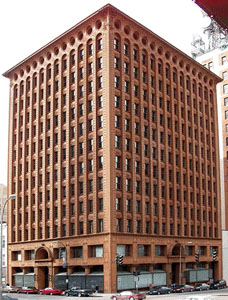
He was an architect, and created the modern skyscraper. He mentored Frank Lloyd Wright. He coined the phrase 'form follows function' in an article about architecture. This phrase sums up what modernism is about, as it should be functional rather than decorative.

There is an organised design to the Guaranty building that he designed.

Skyscrapers represent the upwardly mobile city of business opportunity. Fire cleared buildings in Chicago in 1871 and made way for Louis Sullivan new aspirational buildings.

Charles Scheeler
Fordism
Industry in Detroit

Fordism: mechanised labour relations
Antonio Gramsci essay 1934
In the essay Americanism and Fordism he looks at the production line, where human bodies are used to create maximum productivity with minimal effort and create mechanical movements. 

Modern Times, film by Charlie Chaplain
It's a critique of the idea of the production line. Character suffers a mental breakdown because he isn't good at the job

Stock market 1929
Crash
Factories closing, unemployment goes up

Margaret Bourke-White:


Flaneur
The term comes form the French word for stroller, lounger, loafer. Means 'to stroll'. A bourjois literay figure from the 19th century. Someone who walks around the city and experiences the city from a removed point of view, not a worker. He's not part of the mechanism and how the city works. Part of his role is to record what he says, whether in an artistic or literary way. French poet Charlies Baudelaire says 'He's a person who walks the city in order to experience it'

Walter Benjamin
Adpots the concept of the urban observer as an analytical and theoretical tool and as a lifestyle seen in his writings. The architecture arcades present an uninterrupted view of the city, which is protected from the weather and is an ideal place for the flaneur to walk about.

Photographer as a flaneur
The photographer is an armed version of the solitary walker connoitering, stalking, cruising the urban inferno, the voyeuristic stroller who discovers the city as a landscape of voluptuous extremes. Adept of the joys of watching, connoisseur of empathy, the flaneur finds the world 'picturesque' p55 Susan Sontag On Photography

Flaneuse
Susan Buck-Morss says the only type of women on the street is a prostitute or a bag lady

Sophie Calle Suite Venitienne 1980
Stalks this guy in Venice and takes photos of him without his knowledge, exploring female on male stalking in the city


The Detective 1980
She pays someone to follow her and take photographs of her existance, and she takes photographs of him as well. His photos and notes on her are displayed next to her photos and notes about him. Set in Paris

Here is New York Book/exhibition

Weegee
He had a darkroom in his van, and got to scenes before even the police had as he had a police radio in his van
Reported so many murders and crime scenes
Got there before any other photographers

The Naked City
It is a book of Weegee's photos, then a film was made about it. 

Lorca di Corcia Heads
Sets up lights in the pavement so when people walk past it catches them and he takes photographs, so they almost look like film stills as they appear constructed. He did it in a lot of cities. 

Walker Evans Many are Called
He has a camera under his coat on the subway, he takes photos of people who are unaware of being photographed. 

Ed Soja The Postmodern City

John Meyerowitz Broadway and West 46th Street NY 1976

OUGD504 - Design for Web: Web Session 2

Firstly we bought in the scamps we've done, and we gave everyone a little bit of feedback, I got:


  • Very detailed, I can see where you plan to take it next. Will you be producing the imagery?
  • Straightforward
  • I prefer the second version because I feel it is the most user-friendly
  • 1 + 3 are the best - more clear and better structure. Others seem to have a bit too much going on
  • Detailed scamps which will be useful when converting to digital - well structured layouts and imagery
Dreamweaver Session
When you find the root folder for your site, it comes up in the right column. I double clicked on Index to open it.


I then opened a new site, which was a CSS file.


The comment is actually called a CSS Note


This is how lay out variables in CSS:


Then I saved it as a stylesheet. As I've already told Dreamweaver where the folder is, I don't need to select a new place.


To link a stylesheet to a html file, you need to click the chain icon on the right:


Then you find the css file and attach it:


Fixed Sizes
We're going to start designing with fixed sizes rather than responsive. Going to look at 1024x768 firstly.

Wrapper and Container are the two names used to call a box in the body where all the content goes.

This is setting the width and height of the container:


This is how to add the container to the html:


This is what it looks like in preview:

This how to change the position of the box, as there is a margin by default. Adding a fixed position, and changing the margins of this using top and left.


To change the left side of the position to the middle, we need to make the 'left' 50%.


To make the whole site center aligned we then need to add 'margin-left' and choose -512px because this is half of the width of the site (1024px)


Navigation Bar
We are now going to make a top navigation bar. We made a div id tag in the css file which looks like this:


We then went to create a logo on Illustrator for the bar. 


To save a logo in Illustrator, you need to select Save for Web and choose PNG 24


We save it in the root folder


This is the logo settings in CSS

It looks like this

Rollover button
We then used Illustrator to create a button for the navigation bar, which is 231px by 100px. This is because the nav bar height is 100px, and as there is going to be 4 buttons, 231 is 924/4. 
I created two versions - one that will be a normal button, and one which when the user hovers over will go bold. Then I saved these for web in the images folder.


This is the html so far:

To create the rollover button we go to Insert > Image Objects > Rollover image.


Then we fill in the two pictures that we want to change. Alternate text is when you have to have a name for the image - this is because by law websites have to be acessible by everyone, including blind people. They have software which will read out the alternate text of images to them.


The html now looks like this, as Dreameweaver has added the javascript


OUGD501 - Constructing The Other

This example of advertising shows a man and woman in Calvin Klein underwear laid next to each other. 'Publicity increasingly uses sexuality to sell any product or service', and this is apparent in this advertisement. It could be argued that the couple have just had sex because they both appear sweaty, are wearing underwear and laid next to each provocatively - this would appeal to consumers because they like this idea of sensual sex, and want this in their life. 
The advertisements suggests that they are both irresistible as they are wearing Calvin Klein underwear, and that with this product 'you will become desirable'. The couple are what is generally seen in advertisements - in their 20s, have toned, slim bodies and are wearing designer clothing. This is what society depicts as beauty and so would encourage buyers to get the product so that they can be part of this lifestyle and fit in with what society expects of people.
They are both looking away from the camera with their eyes closed, which allows the viewer to look at them in a voyeuristic manner and impose on their personal lives without being challenged by them. This is so the viewer can envy what they have without feeling ashamed about it, and Berger says they are more envious because 'the more impersonal they are, the greater the illusion'. 
The woman is clinging to the man's underwear which not only shows how attractive and sexy the underwear is, but if men buy this product they will have women clinging to him. This is supported by when Berger says 'if you are able to buy this product you will be loveable', referring to when sexuality is used in adverts, like here. This is something men want, or feel they need, to fit in with the idea that men should be irresistible to women and have competent relationships.
It would also appeal to men because it is a fantasy image of a woman - she is wearing high heels while clutching him while he has a cool, calm expression. Although this is something that can be possible in real life, it doesn't happen and is just out of the buyer's grasp, which makes them want to buy the product as 'publicity is effective precisely because it feeds upon the real'. 
The scale of the advertisement and the fact the woman is looking away allows women to look at the model and then she can 'imagine herself transformed by the product into an object of envy for others'. This make them think that if they buy this product, they have the opportunity to look like this woman. 


Copyright 2010. All rights reserved.

RSS Feed. This blog is proudly powered by Blogger and uses Modern Clix, a theme by Rodrigo Galindez. Modern Clix blogger template by Introblogger.